
Pharmacy First GP Resources
Updated 22/07/2025. Main revisions:
- Pharmacy First service details
- Updated GP Briefing here
- New referral tools and written guidance
Background:
Pharmacy First replaced the previous CPCS on 31 January 2024, adding referrals for 7 clinical pathways to the existing referrals for minor illnesses.
The 7 clinical pathways allow pharmacists to conduct a consultation under PGDs (patient group directions) with the potential of being able to prescribe medication without further reference to a GP or practice. In addition, patients are also able to “self-refer” themselves to a pharmacy for a consultation for one of these 7 clinical conditions.
This builds on the success of CPCS and offers GP practices even more scope to offer a referral to a pharmacy for appropriate patients thereby allowing practices to manage finite appointment capacity to make available more opportunities to see other patients, e.g. those with more complex needs or multiple morbidities.
Where it works well there is clear evidence of closer working between practices and pharmacies, improved local relationships together with same-day outcomes and an enhanced service for those appropriate patients.
Currently there is almost 100% coverage across the county of pharmacies providing the Pharmacy First service for both practices and NHS 111 (NB: pharmacies cannot choose to only undertake referrals for NHS111 or solely practices)
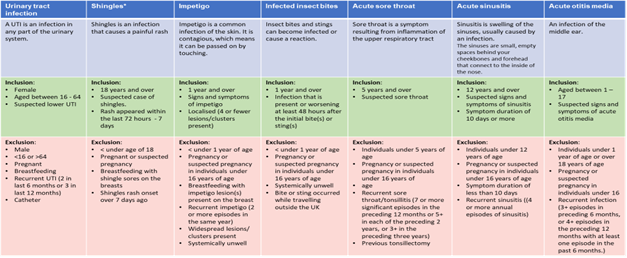
The 7 clinical pathways:
You may now refer patients with:
- Urinary tract infections (female aged between 16 – 64)
- Acute otitis media (aged between 1 – 17)
- Acute sore throat (5 years and over)
- Acute sinusitis (12 years and over)
- Infected insect bites (1 year and over)
- Shingles (18 years and over)
- Impetigo (1 year and over)
Minor illnesses:
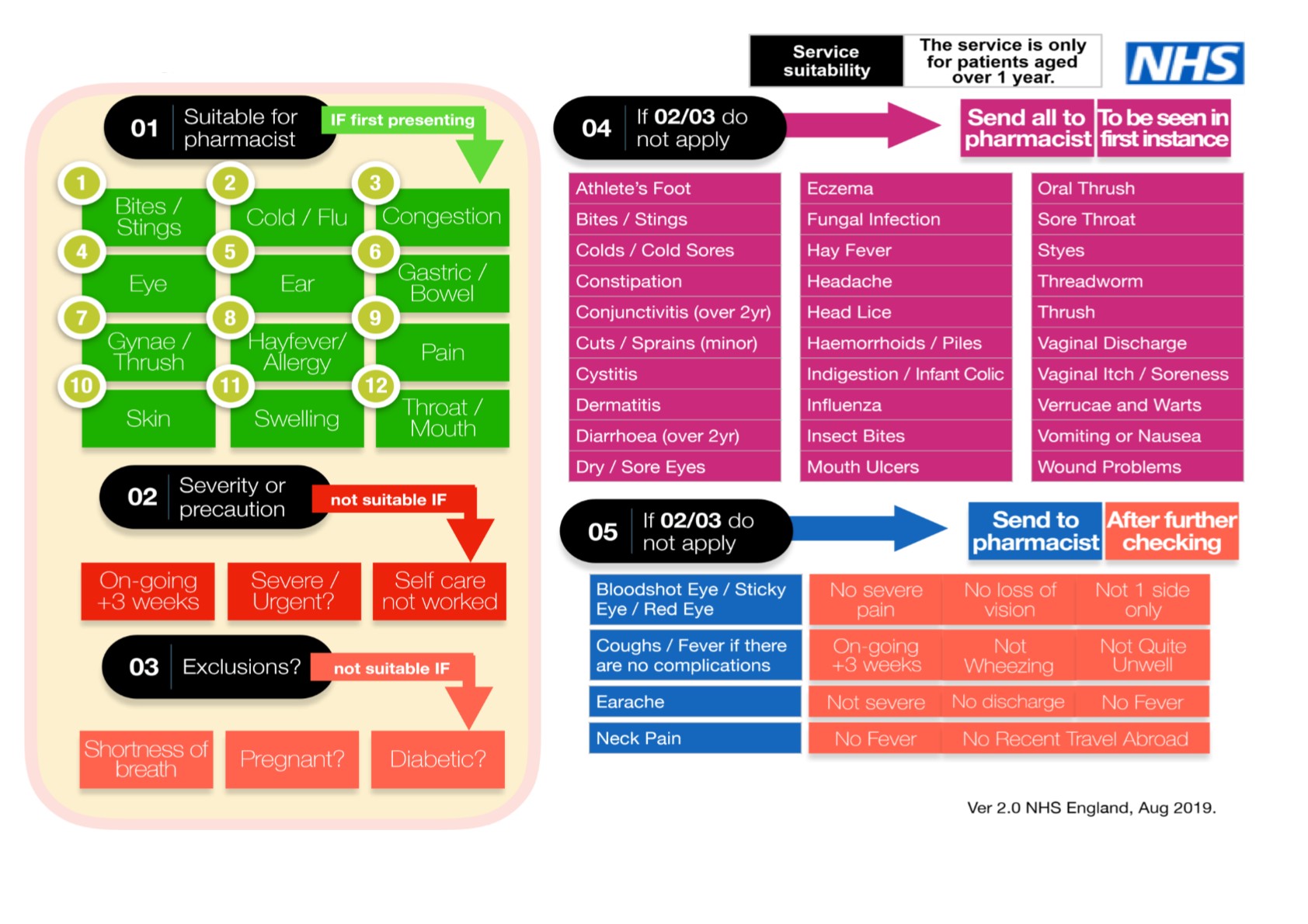
Pharmacy First also still includes the opportunity to refer patients to their choice of pharmacy with over 60 minor illnesses with restrictions as below.
Aide-memoire for practice staff:
The guidance shown below and accessible in pdf format here may be printed double-sided and laminated to give a quick ready reference guide to the appropriate conditions and further guidance on the 7 clinical pathway eligibility and exclusions:
Referring a patient to Pharmacy First:
There are currently three ways to refer a patient for a Pharmacy First consultation (whether the 7 clinical pathways or a minor illness):
- Use the AccuRx template (if available to you),
- Use the SystmOne/Ardens template or
- Send a nhs.net email to the relevant pharmacy
Details of how to do these may be found in the links or information below.
- AccuRx: please follow the guidance in this link:2025 PF Referral Info for GP AccuRx
- Ardens/SystmOne template: please follow the guidance in this link:2025 PF Referral for GPs Ardens (We understand that SystmOne is also developing its own incorporated Pharmacy First referral tool with implementation in the later half of 2025.)
- Send an nhs.net email direct to the pharmacy* and include the patients name, contact details and a brief description of the reason for referral
All of the three above methods sends an nhs.net email to the pharmacy (the referral does not present itself in the workflow of the pharmacy operating system) so we ask that pharmacy teams make regular checks of the pharmacy email during the working day.
NB: in a change from CPCS, the Pharmacy First service specification puts the onus on the patient to contact the pharmacy post referral (therefore providing the patient with contact details for the pharmacy is a must) either in person or by telephone.
Should the patient not contact the pharmacy post referral, the service specification leaves the pharmacist to decide whether they need, in their clinical opinion, to contact the patient. All of our experience suggests (and we also recommend to pharmacies) that the majority of pharmacies would contact any referral after an hour or so if no contact had been made.
Resources to support GP practices with Pharmacy First implementation and referrals:
The earlier section gave a staff aide-memoire for both minor illness and clinical pathways referrals along with details of how to use the AccuRx, Ardens/SystmOne template or a nhs.net email address.
AccuRx and Ardens/SystmOne template users will find that the templates automatically refer to the directory of services and provide the relevant pharmacy details for referral without any further requirement.
* Those practices using solely the nhs.net email will need to find the necessary pharmacy email. Pharmacy email addresses within Lincolnshire are in a specific format:
- pharmacy.ODS code@nhs.net
The ODS code may be found by using this link: ODS Data Search and Export and going to the “advanced search” tab, selecting “pharmacy” from the “primary role” dropdown menu and then completing relevant details. The easiest is just putting your required location in the “town” option which will then give a complete list of pharmacies and ODS codes for that location: